

What Is The Makeup Of Flu A And B In This Year's Flu Vaccine
Each twelvemonth, experts from CDC, Earth Health Organization (WHO), and other institutions study virus samples collected from around the world to identify the influenza viruses that are the about likely to cause disease during the upcoming influenza season. This data is used to create a vaccine.
Because flu viruses are constantly irresolute, information technology is not possible to predict with certainty which types of viruses will predominate during a given season. Influenza viruses can change from one season to the next and can even change within the course of ane flu season. Experts must choice which viruses to include in the vaccine many months in advance in order for vaccine to be produced and delivered on fourth dimension. Because of these factors, there is ever the possibility of a less-than-optimal lucifer between circulating viruses and the viruses in the vaccine.
Most influenza vaccines available in the Usa for the 2020–21 flavour will be quadrivalent vaccines, with the exception of MF59-adjuvanted IIV (aIIV), which is expected to be available in both trivalent (aIIV3, Fluad) and quadrivalent (aIIV4, Fluad Quadrivalent) formulations.
For the 2020–21 flavor, U.S. egg-based influenza vaccines (i.east., vaccines other than ccIIV4 and RIV4) volition contain HA derived from:
- an influenza A/Guangdong-Maonan/SWL1536/2019 (H1N1)pdm09-similar virus;
- an influenza A/Hong Kong/2671/2019 (H3N2)-like virus;
- an influenza B/Washington/02/2019 (Victoria lineage)-like virus; and
- for quadrivalent vaccines only, an influenza B/Phuket/3073/2013 (Yamagata lineage)-like virus. (Grohskopf et al., 2020)
For the 2020–21 flavour, U.S. cell culture–based inactivated (ccIIV4) and recombinant (RIV4) influenza vaccines will contain HA derived from:
- an flu A/Hawaii/lxx/2019 (H1N1)pdm09-like virus;
- an influenza A/Hong Kong/45/2019 (H3N2)-similar virus;
- an flu B/Washington/02/2019 (Victoria lineage)-like virus; and
- an influenza B/Phuket/3073/2013 (Yamagata lineage)-like virus. (Grohskopf et al., 2020)
The 2019–2020) U.South. quadrivalent vaccines contain the same three antigens listed in a higher place and an additional influenza B virus component, a B/Phuket/3073/2013–like virus (Yamagata lineage). Compared with the 2018–2019 season, the composition for 2019–2020 includes updates in the flu A(H1N1) and flu A(H3N2) components of the vaccine (Grohskopf et al., 2019).
The 2020–21 composition reflects updates in the influenza A(H1N1)pdm09, influenza A(H3N2), and influenza B (Victoria lineage) components (Grohskopf et al., 2020).
For the 2020–2021 season, routine annual influenza vaccination of all people aged ≥6 months without contraindications continues to be recommended. A licensed, recommended, and historic period-appropriate vaccine should be used (Grohskopf et al., 2020).
A quadrivalent live adulterate flu nasal spray vaccine (LAIV4) made with adulterate (weakened) live flu viruses, is approved for use in people 2 years through 49 years of historic period. This vaccine is non recommended for utilize in pregnancy or for people with some specific medical conditions (CDC, 2019b).
People with egg allergies can receive any licensed, recommended, historic period-advisable influenza vaccine that is otherwise appropriate. People who accept a history of astringent egg allergy (those who have had any symptom other than hives after exposure to egg) should be vaccinated in a medical setting, and supervised by a healthcare provider who is able to recognize and manage astringent allergic reactions (Grohskopf et al., 2020).
Balancing considerations regarding the unpredictability of timing of onset of the influenza season and concerns that vaccine-induced immunity might wane over the grade of a flavor, it is recommended that vaccination should be offered past the end of October. Children aged 6 months through 8 years who require ii doses should receive their first dose equally shortly as possible later on vaccine becomes available, to permit the 2nd dose (which must be administered ≥4 weeks later) to be received past the terminate of October (Grohskopf et al., 2020).
Customs vaccination programs, however, should remainder maximizing likelihood of persistence of vaccine-induced protection through the season with avoiding missed opportunities to vaccinate or vaccinating after onset of flu circulation occurs. No recommendation is made for revaccination later in the season of persons who have already been fully vaccinated (ie, providing a booster dose) (Grohskopf et al., 2020).
For a tabular array of approved influenza vaccines for the 2020–21 season, click here.
Giving an Influenza Vaccination via Needle
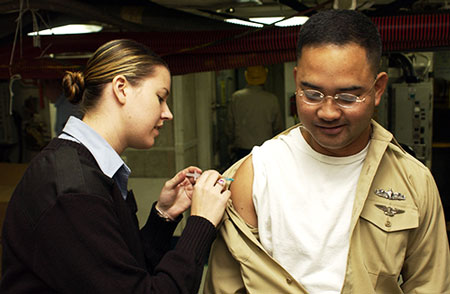
Source: United States Navy. Public domain.
Source: https://www.atrainceu.com/content/11-makeup-influenza-vaccine-2020%E2%80%932021-season
Posted by: milessuar1975.blogspot.com
0 Response to "What Is The Makeup Of Flu A And B In This Year's Flu Vaccine"
Post a Comment