

Testing Intel Whiskey Lake CPUs: Core i7-8565U Review
Intel unveiled a new serial of U-series laptop processors last yr designed for ultraportables. We'll use the term "new" loosely here. These CPUs are codenamed Whiskey Lake, and they're still 8th generation parts that are non radically different from the previous Kaby Lake Refresh fries that came before it. The main change is the move from Intel's 14nm+ to their 14nm++ procedure node, which has immune slightly higher clock speeds within the aforementioned power envelope.
The bones blueprint of these CPUs is unchanged which is probably why they are nonetheless existence called eighth-gen parts, rather than 9th-gen to fit in with Intel'due south current desktop line-upwardly. There are but 3 SKUs: the Core i7-8565U and Core i5-8265U that are four core / 8 thread CPUs, while the Core i3-8145U is a dual-core part with 4 threads. All are 15W chips although the TDP can exist configured anywhere from 10W to 25W depending on what the OEM wants.
The focus of this review will be the Core i7-8565U, which is substantially the new flagship 15W CPU in Intel'due south line-up.

This is a little confusing as previously there was a Core i7-8650U, but the 8565U is actually clocked higher, at a single core turbo clock of 4.6 GHz (upwards from 4.2 GHz) and an all core turbo of four.one GHz, up from 3.nine GHz. The base of operations clock is a little lower though, at i.8 GHz compared to i.9 GHz. And these clock speed increases are even more favorable when comparing the i7-8565U to the i7-8550U which is a more like-for-like comparison going on the naming scheme; comparing those 2 CPUs gives at least an eleven% boost clock advantage to Whiskey Lake.
Information technology seems that a lot of OEMs weren't super excited past Whiskey Lake considering we didn't run into a lot of laptop refreshes in 2022 that decided to use these new parts. It wasn't until recently during CES 2022 that more than vendors are jumping on board, and I doubtable that'southward due to small clock speed increases, making it less of an urgent or necessary upgrade.
In preparation for new 2022 laptop releases we're going to be detailing how Whiskey Lake – specifically the Core i7-8565U – performs in comparison to a range of other laptop-class processors. This should give you a good idea of how this CPU stacks upwards, it won't exist a perfect reflection because laptop vendors tin can change a number of aspects including the cooler, memory configuration and TDPs which all impact operation, but what I'll be showing today should be very shut to what y'all'll see in well-nigh laptop implementations.

Crucially, we've tested the Core i7-8565U using the new Razer Bract Stealth which is an excellent test platform for a number of reasons.
The new Blade Stealth uses the 25W maximum TDP configuration for this CPU, so nosotros'll meet how this chip performs in devices that choose this configuration and have larger coolers. Dell, for example, tends to utilise 25W for their XPS line. Then, using Intel's Extreme Tuning Utility, we've too been able to fix the CPU downwardly to its regular 15W configuration, this is the most mutual configuration and reflects the majority of ultraportables that will use this CPU.
Having both sets of data should requite a pretty comprehensive look at how this processor performs.
The Blade Stealth is also a good platform because it includes 16GB of dual-channel DDR4, once more, a common configuration and dual-channel is key because the best performing laptops accept dual-channel retention. On top of this, the laptop also has GeForce MX150 graphics, however for the purpose of our testing we've disabled the discrete graphics. Our full review of Razer Blade Stealth is coming up before long, where nosotros'll test the bodily operation of this laptop with its discrete GPU.
A few other things we should mention virtually Whiskey Lake before the criterion results... the GPU and cache configuration are unchanged compared to Kaby Lake Refresh. And then we're withal looking at UHD 620 graphics at up to 1150 MHz in the Core i7-8565U, along with 8MB of L3 cache. Typical PL2 power limits likewise appear to be unchanged, so we're still looking at short bursts using up to 44W with the 15W configuration, and 51W with the 25W configuration.
Benchmarks
Starting with Cinebench R15, the multi-threaded test is a relatively short benchmark simply it has a decent mix of boost and steady country clock speed beliefs. Despite higher boost clocks, the 8565U in its 15W configuration ends upwardly merely 3% faster than the 8550U in the multi-threaded test.
The 25W configuration gets a healthier xi% boost, which is in line with the heave clock difference. Both configs are a fair bit faster in the unmarried-threaded test though.

To explain what's going on here, it's worth looking at a clock speed comparison during the Cinebench run. Both the 15W and 25W configurations outset off at their maximum all cadre Turbo clock speed, which is three.7 GHz for the 8550U, and 4.one GHz for the 8565U. However when the CPU reverts to its PL1 state, so it's no longer boosting whatever more than, there is quite a difference in beliefs.
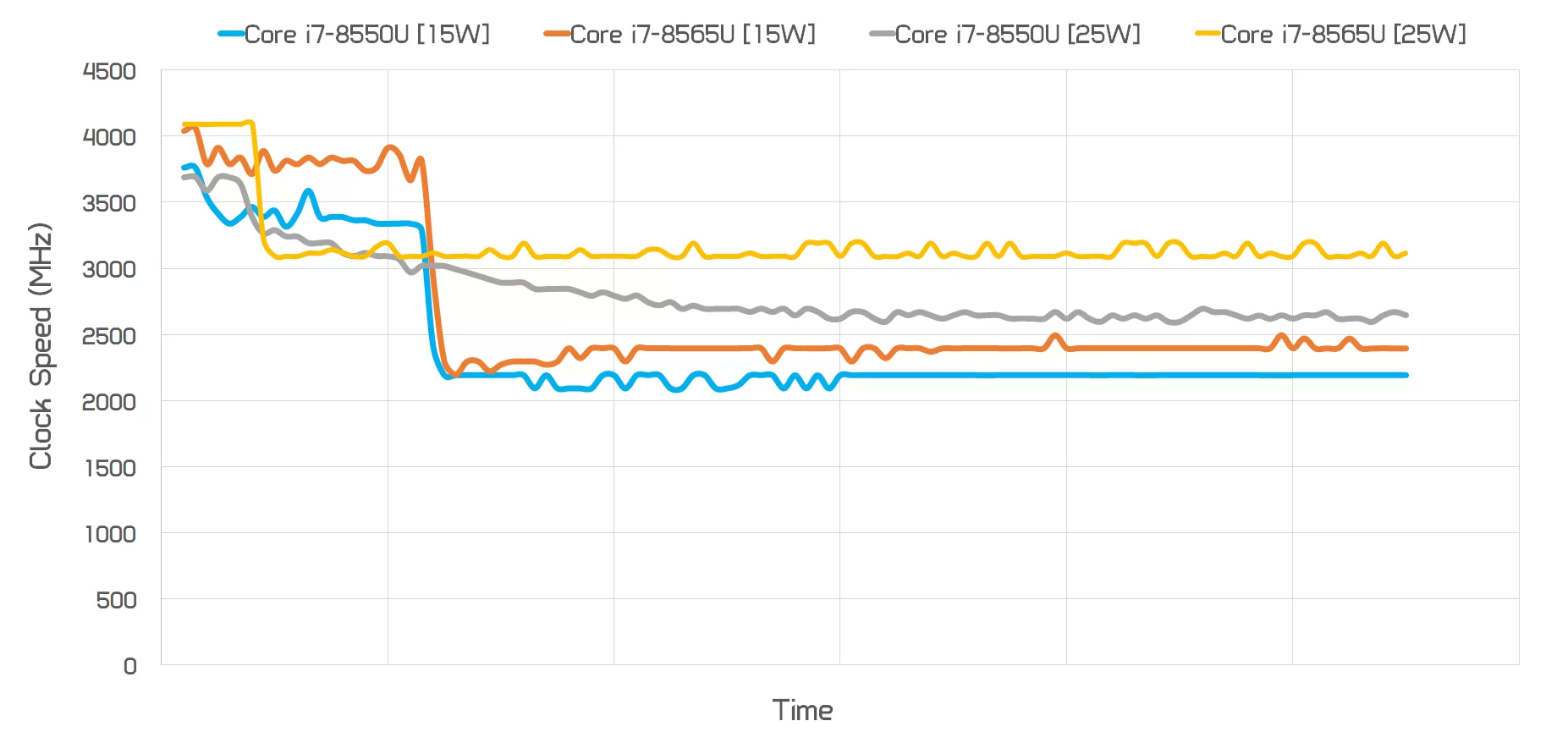
The 25W 8550U is sitting around the 2.half-dozen to 2.7 GHz mark, withal the 25W 8565U is upwardly at 3.1 GHz, and so that's quite a healthy gain for the 8565U and contributes to the larger gain in performance. When looking at the 15W CPUs, the 8550U sits at 2.ii to 2.3 GHz compared to 2.3 to 2.four GHz for the 8565U. At that place is a gain for the 8565U, but it'south non as large as you get at 25W.
What's credible here is that the advantage that 14nm++ brings to Whiskey Lake isn't all that accessible with a tiny 15W ability limit. You do get a decent jump in boost clock speeds, simply when the CPU reverts to its long term PL1 power state, at that place'due south not a lot to be gained from the 8565U. All the same at 25W, the taps are opened a scrap more and Whiskey Lake can stretch its legs to provide a decent bound in functioning.
Looking at the Cinebench R15 operation chart once again, it's also impressive to encounter where the 25W configuration is sitting amid the pack. The 25W 8565U is almost as fast as the Core i7-7700HQ in the multi-threaded examination, and information technology smokes it in the single-threaded exam. The 7700HQ is a 45W quad-core designed for gaming laptops, then it'south great to see that performance now bachelor in ultraportable class factors.

We see a similar situation in x264 encoding, the 25W 8565U is right upwardly there with the 7700HQ, while the 15W configuration is providing up to an 8% gain over the 8550U.

Handbrake x265 was a really interesting criterion to run equally it shows an even harsher reality for the 15W configuration of these CPUs. With this TDP limit, there was no deviation in functioning between the 8550U and 8565U, likely due to the use of AVX instructions that further limit what depression-power CPUs tin achieve.
However with the 25W configurations, the 8565U is a good 17% faster, which is slightly above the divergence in long term clock speeds. We also encounter that while the 8565U was close to the 7700HQ in previous tests, when AVX is required, the 7700HQ and other 45W CPUs begin to pull away.

Adobe Premiere benefits strongly from GPU acceleration and the iGPU in these 15W CPUs is pretty weak. Y'all can run into that the tiptop three CPUs that are paired with discrete-class graphics smoke the contest here. We likewise encounter the 15W 8565U fall slightly behind the 8550U, a strange upshot and the only criterion where this was the case. That said, the 25W configuration is now 14% faster.

Microsoft Excel is a workload that runs entirely inside the PL2 boost state, so there is no difference in performance between the 25W and 15W configurations. The i7-8565U holds a small advantage over the 8550U, and both sit down effectually the same mark every bit the 7700HQ, another impressive showing.

MATLAB is some other good result for the 8565U, with an viii% gain present with the 15W configuration over the 8550U, while the 25W config jumps that upward to a 14% gain. Again in this curt-burst, unmarried-core workload in that location's not a lot of difference between well-nigh of Intel's contempo CPUs, and considering it also thrives on memory bandwidth where there has been near no comeback, we're left with a big clumping at the acme of the nautical chart.

With vii-Zip we see pocket-sized gen-on-gen improvements with Whiskey Lake once more, mostly because this exam is short and runs in the heave clock zone.

Adobe Photoshop shows some of the largest gains betwixt generations with the 15W SKU delivering xiii% more performance and the 25W SKU showing gains of 26%, much higher than the boilerplate.

Information technology's as well worth looking at PCMark x where we meet decent generational gains betwixt each CPU once more. The 15W SKU provides 12% more performance, which is in line with some of the single-threaded curt outburst workloads nosotros've seen, and that'south largely what PCMark tests.

Briefly touching on GPU performance, there'south not a lot to say considering there are no changes to the GPU in Whiskey Lake compared to Kaby Lake Refresh. Big gains are expected for the next generation, but we're not getting annihilation here.

Looking across our 3DMark workloads similar Sky Diver, well-nigh of the gains you're seeing are from college CPU scores, while looking at pure GPU scores there is side by side to no improvement. In more GPU intensive workloads, Whiskey Lake nevertheless gets handily beaten past AMD'south Ryzen Mobile processors.
Permit'southward at present look through some overall summaries of how the Cadre i7-8565U performs...
On average, the 15W configuration of the 8565U is 8% faster than the 8550U, though these gains largely appear in either single-threaded workloads, short workloads, or some combination of the ii. In longer workloads like encoding, you can await less than a five% functioning improvement.

When comparison 25W configurations, the gains are more than significant. Here we're upwardly to a xv% improvement on average with quite a healthy gain in longer workloads. This is more in line with the clock speed differences between the two processors; the 8565U is simply clocked higher then y'all can wait it to perform better, specially with a higher power limit.

The 25W Core i7-8565U is also now delivering performance in line with the 45W Cadre i7-7700HQ in some workloads; the 8565U is less than 1 percentage behind on boilerplate. This means that in the space of roughly two years, Intel has been able to have gaming laptop level CPU performance and put that into ultraportable-type chassis. Certain, you demand to utilise the upper-end 25W configuration to reach this, but it's impressive nonetheless.

And finally comparison the 15W 8565U to even just the Core i7-7500U from a few years ago. It's a no-contest. With double the core and thread count, the 8565U is on average 35% faster and that margin only increases when looking strictly at multi-core workloads. If you're coming from a dual-core ultraportable to a quad-core Whiskey Lake system, expect to see significant performance improvements across all workloads, either from the doubling of cores or from large clock speed gains.

Wrap Up
In that location are a couple of ways to wait at what Whiskey Lake brings to the table. On one hand, there'south not a lot to be gained in its 15W configuration. We're looking at by and large single-digit improvements and sometimes for longer workloads, no improvements compared to Kaby Lake Refresh. Intel's 14nm node is clearly limiting and the shift to 14nm++ can only do so much.
The best yous'll get from Whiskey Lake is in its 25W configuration where functioning improvements tend to match the clock speed gains more closely at around a 15% comeback. Withal it'southward rare to find a 25W organization. The 15W config is much more common, then for the majority of buyers looking at a Whiskey Lake organization, there's not a lot of incentive to upgrade from Kaby Lake Refresh or to buy a Whiskey Lake organisation if it costs more than a last-gen Kaby Lake-R car.

All the same it's hard non to be impressed with what Intel has achieved over the concluding few years without significant advances to process engineering. Sure, on the desktop 14nm+++ is now a bit of a joke and operation gains – outside of increased core counts – are anywhere from unimpressive to non-existent.
But on the mobile side, within the aforementioned sorts of ultraportable laptop designs we've gone from two cores at modest clock speeds, to 4 cores at reasonably high clock speeds, on largely the same process node and architecture. Functioning that used to exist restricted to gaming laptops is now accessible in more portable form factors, which is very impressive.

And while Whiskey Lake isn't a huge pace over Kaby Lake Refresh, it will be a massive comeback to anyone upgrading from a seventh-gen system or earlier. Typical laptop upgrade cycles are quite long. If yous're using a four year former laptop for case, you lot can expect huge improvements upgrading to something 8th-gen. That said, I'd nonetheless shop around because you don't necessarily need Whiskey Lake to access those gains, Kaby Lake-R is also fine.
In that location is still one lingering issue with Intel'south mobile processors, and that'southward the GPU side. With basically zero improvement in this department for generations now, Intel is lagging way backside what is required for a modern ultraportable. AMD realized this as their beefy Vega GPU in their Ryzen Mobile APUs handily crush Intel'due south integrated graphics. Lots of OEMs accept besides realized, and are starting to pair Nvidia'southward MX150 discrete GPU with Intel's 15W CPUs to get that extra GPU performance.

It does seem like Whiskey Lake is a bit of a stop gap until Intel tin can get their 10nm CPUs out the door at the end of 2022, which volition bring a much larger and competitive Gen11 integrated GPU.
With merely v to 15% performance gains on the CPU side, it's all Intel could practice at this point. OEMs are not exactly rushing out Whiskey Lake systems and we believe the modest gains are a reflection of that.
Shopping Shortcuts:
- Razer Blade Stealth on Razer.com, Amazon
- More Core i7-8565U equipped laptops on Amazon

Source: https://www.techspot.com/review/1782-intel-whiskey-lake-core-i7/
Posted by: milessuar1975.blogspot.com
0 Response to "Testing Intel Whiskey Lake CPUs: Core i7-8565U Review"
Post a Comment